|
Budget Reform
Members of the moderate Republican Tuesday
Group and the conservative Republican Study Committee unveiled
a set of 12 consensus principles to reform the budget process.
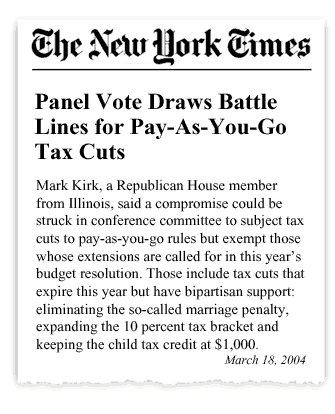
The bill written by Congressman Kirk and chiefly negotiated by
Kirk and Congressman Mike Castle (R-Del.), Congressman Jeb Hensarling
(R-Texas), and Paul Ryan (R-Wis.) outlines principles that include
automatic spending reductions, so-called PAY/GO rules and other
mechanisms to reduce the deficit. In addition, Kirk's bill would
create discretionary spending caps and 'firewalls' separating
defense, and rescissions of individual spending items deemed wasteful.
"These principles stand for the key
value that once we adopt a budget, we must have the tools to stick
to it," said Congressman Kirk. "If these principles
are adopted, taxpayers and markets will be assured the federal
government will spend within its budget."

Cut Federal
Spending
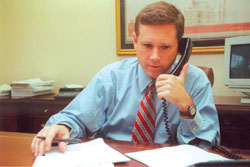
Congressman Kirk voted against the $274 billion
Farm Bill because the proposed legislation was too expensive and
added to our national debt. As a member of the powerful Appropriations
Committee, Congressman Kirk voted against 10 amendments that would
have increased government spending by $24.4 billion. Kirk is working
to cut spending on the wasteful sugar subsidy program that will
save taxpayers over $500 million annually.
Government
Accountability
Congressman Kirk introduced the Good Government
Accounting Act (H.R. 5094) to assure the independence of the Federal
Accounting Standards Advisory Board and spearheaded changes that
were later adopted by the principals of the Advisory Board.
Congressman Kirk authored an amendment
to the Supplemental Appropriations for Reconstruction of Iraq
and Afghanistan (H.R. 3289). The Kirk Amendment (H. Amdt. 411)
tightens rules that govern government contracts in Iraq to strengthen
accountability.
|